
On a social level, morals are a representation of a society’s modes of production. On a personal level, morals are a representation of an individual’s biological interests. What morals never are is the result of independent philosophical contemplation.

There are no logical moral values. It’s as simple as this. All moral values are perceived values. They are highly arbitrary. The moral values of current democratic societies are no more correct than the moral values of slave-holding ancient Rome, or of cannibalistic societies in Melanesia 200 years ago. They are just different.

Moral relativism
https://en.wikipedia.org/wiki/Moral_relativism
That the moral values of ancient societies were different from current moral values is greatly related to the fact that the modes of production in ancient societies were different. Because our social existence determines our consciousness, including what we consider moral or immoral, living in different forms of societies (which are based on different modes of production) will result in holding different moral views.
An explanation of the Marxist view on how morals (and other elements of the superstructure) relate to societies and their modes of production can be found at the following link (on the linked page, scroll down to the headline “Base and Superstructure”).
Historical Materialism
http://www.age-of-the-sage.org/philosophy/history/marx_historical_materialism.html
That all moral values are just a matter of personal choice is an element of Sartre’s existentialism, which in itself is a form of subjective materialism. Sartre’s famous dictum that "existence precedes essence" captures this idea: we exist first, and define our purpose later.
“Sartre stressed individual moral responsibility over structural causation but without denying the importance of the latter.”
http://plato.stanford.edu/entries/sartre/
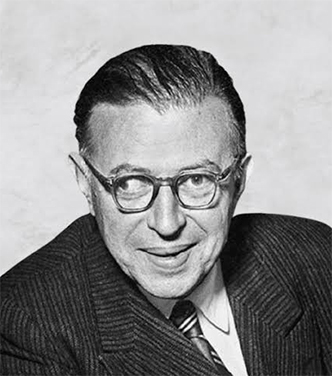
(19050-1980)
On the other hand, Sartre attempted a synthesis of humanism (for which self-determination is a central concept) and materialism.
“Though critical of its bourgeois variety, Sartre does support an existentialist humanism the motto of which could well be his remark that ‘you can always make something out of what you’ve been made into’.”
http://plato.stanford.edu/entries/sartre/
This, of course, supports the assumption that morals are arbitrary, even though it adds a humanistic dimension of responsibility.
The moral values of current democratic societies may be of a more gentle (and humanistic, and more humane) kind than those of slave-holding Rome or historical Melanesian cannibals. But we should be prepared for the fact that the moral values commonly accepted today will feel as outmoded to humans who live a few hundred years from now as the moral values of slave-holding Rome or Melanesian cannibals feel outmoded to most people now.
Comparing the complexity of the law applied in modern societies with the relative simplicity of the law of primitive societies, we can conclude that today’s moral values are more sophisticated. But the more sophisticated moral values become, the more difficult it is to recognize that they are just as arbitrary as simple moral values.
No amount of moral sophistication, nor the creation of ever more complex ethical and legal systems, will enable us to overcome the most basic dilemma: that there is no philosophical or biological basis for why any kind or form of ethics should be preferable in principle to any other kind or form, or, for that matter, to the absence of all kinds or forms of ethics.
But while there may not be a philosophical or biological basis, there may well be a practical basis for preferring a complex and gentle moral system over a more simple and brutal one: we prefer a peaceful society over a violent one.
The initial conclusion that there are no logical moral values per se is closely related to the cognition that, for however long we may be able to extend the human lifespan, the individual lives of each of us will definitely end with our individual deaths. No rebirth, no afterlife. And regardless of how long we live, when measured against the logical endlessness of time, each of us exists for only an infinitesimally short moment. But when we are dead, we are gone forever.
It doesn’t matter whether we were “good” or “bad”. When we are dead, there will be no reward and no punishment.
But for as long as we do occupy the surface of this planet, it makes sense to stay out of trouble. It is only natural that we do not want to become the victims of crime, and that we do not want to become the victims of so-called justice, being incarcerated by authorities, or murdered by the institutions of states that perceive truth in moral values which we know are fictitious.
So, as moral values are fantasies, what is real?
At the core of our existence are biological parameters, not ethical ones. Our interests in shelter and food, our instinctual desire to live and not to die, our fear of pain and sorrow. And most of all: our plain sexual urges.
As argued above, in a social context, the moral values of specific societies are always a representation of the modes of production of the respective societies.
On a personal level, the moral values of any given individual who professes to possess moral values are, more than anything else, a representation of that person’s biological interests, specifically his or her sexual interests.
This is why men who have problems competing for sexual success in pluralistic market economies will typically subscribe to moral values that allocate just one woman to every man. Such moral values, they feel, will guarantee them their fair share of one woman each (because promiscuity is restricted).
Biological and sexual interests are also the emotional force behind the observation that older and less physically attractive women in pluralistic market economies tend to uphold stricter moral rules than young and beautiful women. The stricter the moral rules, the easier it is for older and less attractive women to fend off the competition of those who are younger and more beautiful.
There are many other facets of how the modes of production determine the moral values people subscribe to (if indeed they do subscribe to any), such as the ability to control sexually transmitted diseases.
And there are ongoing sophistications in human modes of production which will have a major impact on sexual morals, such as our emerging capability, via cosmetic surgery, to provide both women and men with a lifelong youthful appearance.
Such modes of production, or technologies, will allow those individuals who are economically successful (and possess the intellectual capacity to be just that) to also remain the most physically attractive, whatever their age.
Educated women who are, chronologically, 50 years old, but look as if they were 25, and thus maintain the highest sexual market value, do not have to make an intellectual escape into feminist morals that decry sexist attitudes in our societies. Instead, they can profit from these very attitudes.