
Kreutz Ideology advocates a materialistic approach to understanding the world.
“Materialistic”, in this context, does not mean being driven by concerns for material benefit.
The materialism I refer to is a philosophical concept, built on the conviction that for everything that happens in the world, even in the realm of love and sex, there is a cause in the material world, and this cause can perhaps be investigated and understood. This is what science is about.
If causes have been investigated and understood, they can be reenacted or created. This is when we take the step from science to technology and engineering.
Science and technology are applicable to the emotion of missing a loved person no less than they are to bridging the Mississippi River. Which is why the first series of articles I ever wrote on love and sex was headlined “Engineering love”.
The opposite of philosophical materialism is philosophical idealism. Now, this idealism doesn’t refer to us being idealistic in that we try to build a better world, or, on a smaller scale, a working long-term love relationship. Philosophical idealism refers to the idea that there is something outside the material world, on which the material world depends.
“Idealism is the doctrine that ideas, or thought, make up either the whole or an indispensable aspect of any full reality, so that a world of material objects containing no thought either could not exist as it is experienced, or would not be fully ‘real.’ Idealism is often contrasted with materialism, both belonging to the class of monist as opposed to dualist or pluralist ontologies. (Note that this contrast between idealism and materialism has to do with the question of the nature of reality as such. It has nothing to do with advocating high moral standards, or the like.)”
Source: Wikipedia: Idealism
I am not a philosophical idealist. I am a philosophical materialist. I understand that humans, though not all of them, can understand to a certain degree what happens in the world.
As they say: the proof of the pudding is in the eating. Or, the proof of our understanding is that we can make it. This applies equally to constructing bridges and to constructing optimal relationships of love and sex.
However, there is an important twist to all of this. It is not just that, inasmuch as we understand the world, we can create it, but that, whether we understand the world or not, it always also creates us.
When Darwin summarized the emerging knowledge on the origin of species, and when, subsequently, humans developed the knowledge of genetic engineering, it wasn’t just that we got better at shaping our world. Our new technologies also reflected back on us to no small degree. Idealism took a major blow. And again, idealism will take another blow when medical science advances to a stage, as it surely will, where, in principle, it can afford humans an indefinite life span.
Alas, we are not quite there yet.
But regardless of when our technologies will have sufficiently evolved for this exciting prospect, the fact remains that it is our technologies, or (to use an older and wider designation) our modes of production, that shape our opinions, and that only with sufficient cognition can we see beyond this.
Just as our knowledge of the origin of species has important roots in 19th-century philosophy, so does our understanding of the manner in which our modes of production reflect back on our minds.
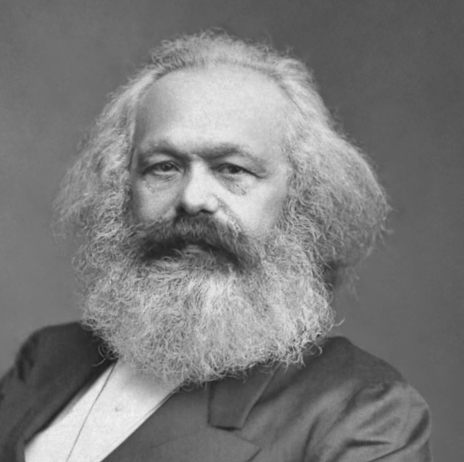
(1818-1883)
The following is quoted from the preface of Karl Marx’s A Contribution to the Critique of Political Economy, written in 1859:
“The general conclusion at which I arrived and which, once reached, became the guiding principle of my studies can be summarized as follows. In the social production of their existence, men inevitably enter into definite relations, which are independent of their will, namely relations of production appropriate to a given stage in the development of their material forces of production. The totality of these relations of production constitutes the economic structure of society, the real foundation, on which arises a legal and political superstructure and to which correspond definite forms of social consciousness. The mode of production of material life conditions the general process of social, political and intellectual life. It is not the consciousness of men that determines their existence, but their social existence that determines their consciousness.”
Source: Marxists Internet Archive
In the original German version, the above quote reads like this:
„Das allgemeine Resultat, das sich mir ergab und, einmal gewonnen, meinen Studien zum Leitfaden diente, kann kurz so formuliert werden: In der gesellschaftlichen Produktion ihres Lebens gehen die Menschen bestimmte, notwendige, von ihrem Willen unabhängige Verhältnisse ein, Produktionsverhältnisse, die einer bestimmten Entwicklungsstufe ihrer materiellen Produktivkräfte entsprechen. Die Gesamtheit dieser Produktionsverhältnisse bildet die ökonomische Struktur der Gesellschaft, die reale Basis, worauf sich ein juristischer und politischer Überbau erhebt und welcher bestimmte gesellschaftliche Bewusstseinsformen entsprechen. Die Produktionsweise des materiellen Lebens bedingt den sozialen, politischen und geistigen Lebensprozess überhaupt. Es ist nicht das Bewusstsein der Menschen, das ihr Sein, sondern umgekehrt ihr gesellschaftliches Sein, das ihr Bewusstsein bestimmt.“
Source: ML-Werke
You can read an explanation, written more than 70 years ago, through the following link:
Society and Mind in Marxian Philosophy
To conclude that our minds mirror our modes of production is good science. But there is an anachronism in Marx’s thought. If the modes of production determine ideologies anyway, then the interference of communist revolutionaries would be obsolete.
But Marx himself was a child of his times, when socialism among intellectuals was a fashionable idea.
Furthermore, his analysis of everybody belonging to a social class, the interests of which are reflected in their consciousness and ideologies, had more appeal in the 19th century but is less applicable to the more pluralistic and globalized present times. Nevertheless, it remains true that while, on a social level, everyone’s consciousness and ideology are a representation of the modes of production, this consciousness and ideology are, on an individual level, a representation, or simply a rationalization, of a person’s interests.
I myself, of course, cannot escape the fact that my own ideology, too, is a representation of both current technologies and my individual interests. However, I have at least some awareness of this interdependence.